Local GPU Inference Economics: The Break-Even Is Utilization, Not Hardware Price
Local GPU inference economics are decided by sustained utilization and workload shape — not GPU sticker price. Here's the threshold, the VRAM math, and the routing rule.
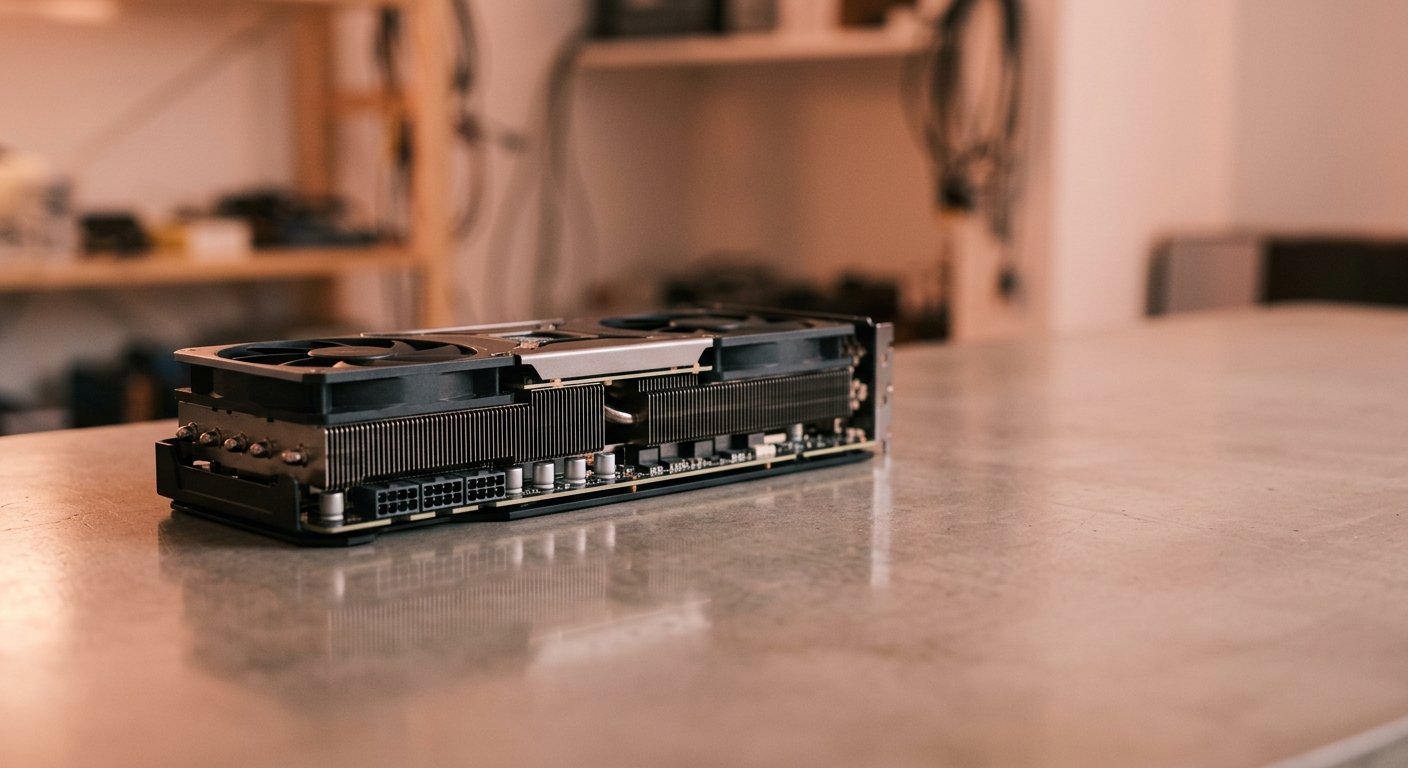
Local GPU inference economics are decided by sustained utilization and workload shape — not by the GPU's sticker price or the cloud provider's per-token rate card. A $1,600 RTX 4090 running at 3% utilization is more expensive per active token than any hosted API endpoint on the market, and any spreadsheet that ignores that fact belongs in the bin.
The local-vs-cloud debate, as it is usually staged, is the wrong frame. The operating model that wins is a routed hybrid: regulated and high-volume workloads stay on-premise where utilization is real and data never leaves the building, while spiky, low-volume, interactive traffic burns someone else's GPU. This post gives you the utilization threshold, the VRAM-per-concurrent-request budget, and the routing rule that decides which workloads belong on owned hardware and which should never touch it.
Sticker-price breakeven without a utilization number is fiction
Every GPU procurement deck runs the same calculation: buy the card, compare it to hosted GPU rental, declare a payback period, sign the PO. One widely cited 2026 guide pegs the RTX 4090 breakeven against A100 rental at roughly 3,500 hours of active use — about 146 days of 24/7 operation [3]. That number is only meaningful if the GPU runs 24/7 doing useful work. It almost never does.
Realistic utilization for a single-team local deployment sits between 2% and 5% of wall-clock time. Office hours, idle gaps between prompts, weekends, holidays, and the fact that humans don't generate tokens at a constant rate mean the hardware that pays back in 146 theoretical days takes years in practice — or never breaks even before the next GPU generation makes it obsolete. For typical batch-size-1 local usage, the energy bill alone can exceed the cost of a $25/month hosted tier [6]. The card isn't just failing to pay back its capex; it's losing money while sitting on the desk.
Honest local-inference math starts with a utilization number, not a hardware price. If you can't defend 40%+ sustained GPU-hours against measured demand, your cost-per-active-token quietly exceeds whatever API you were trying to replace.
Model weights fit. The workload doesn't.
The most common local-inference postmortem isn't "the model didn't fit" — it's "the model fit fine, but we could only serve one user at a time." That failure mode lives in the KV cache, which almost no procurement model accounts for. A 100K-token context window for RAG over internal contracts and compliance documents consumes roughly 25 GB of VRAM in the KV cache alone — about a third of an 80 GB A100 before the model weights or any other overhead are loaded [1].
Inference-only weight footprints are the easy part: roughly 14 GB for a 7B model, 26 GB for a 13B, 60 GB for a 30B [3]. Long-context RAG — which is exactly what enterprises want local inference for — is dominated by the per-request cache, and that cache scales linearly with concurrency. A deployment that looks comfortable at one user gets hard-capped at two concurrent requests once context length grows, regardless of how much headroom the weights appeared to have. Cache management, not parameter count, is where the next round of cost reduction is being fought [7].
Size local hardware by VRAM-per-concurrent-request at your target context length, not by model size. If you can't state that number, you don't have a deployment — you have a demo.
Batch size 1 is the most expensive way to run a GPU you already own
Interactive single-request inference is the worst-case economic configuration for any GPU, owned or rented. Batch size 1 minimizes user-facing latency but leaves most of the silicon idle between tokens; large batches do the opposite, raising throughput and lowering cost per request at the expense of latency [2]. Hosted providers have already internalized this by splitting the same model into latency tiers — a cheaper high-batch service around 30–80 tokens/sec and a premium low-batch tier above 100 tokens/sec, with Anthropic's faster tier running roughly 2.5x the speed at 3x the price [2].
On owned hardware, the same tradeoff is invisible until the electricity bill arrives. Most local users run batch size 1, and at batch size 1 the energy draw alone can outpace a $25/month hosted tier [6]. Power, cooling, and amortized idle time dominate the operating cost of edge inference once you account for realistic duty cycles [8].
Owning a GPU does not exempt you from batch economics. It hides them in a different line item.
The unit of economics is tokens per month per latency tier, not dollars per GPU
Any procurement conversation that starts with "which GPU should we buy" is already off the rails. The unit that matters is tokens per month, segmented by latency tier and data-sensitivity class. Break-even periods land within a few months for small models, around two years for medium models, and about five years for large models — and on-premise is most viable for organizations processing at least 50M tokens/month or operating under strict data-residency mandates [5].
Below that volume, owning hardware is a sovereignty decision, not a cost decision. That is a legitimate reason to do it — GDPR, classified data, contractual data-residency clauses, air-gapped environments — but the business case has to name it honestly. Pretending a 5M-token-per-month workload is cheaper on owned silicon than on a hosted endpoint produces bad procurement, underutilized clusters, and a CFO who stops trusting the AI team's numbers six months in. Above 50M tokens/month with predictable demand, the math inverts and local inference becomes defensible on cost alone.
Hybrid routing beats ideological cloud-exit
The architecture that wins on inference economics is not all-local and not all-cloud. It is a router. Regulated workloads — anything touching personal data, contracts, financials, or IP that cannot leave the jurisdiction — stay on owned GPUs. High-volume, predictable workloads with stable concurrency stay on owned GPUs, because that's where the utilization math works. Everything else — spiky internal tools, experimental features, latency-tier-2 batch jobs, occasional bursts above local capacity — routes to hosted endpoints or rented GPU capacity, where you pay only for the tokens you actually consume.
Inference traffic is bursty, and any single-tier architecture either overprovisions for the peak or fails at the peak [4]. The enterprise version is simpler: a cluster sized for your worst Monday morning sits at 4% utilization on Wednesday afternoon. A cluster sized for Wednesday afternoon throttles on Monday. Routing solves both problems by separating the predictable, sensitive base load from the volatile, non-sensitive overflow — without forcing a religious commitment to either side of the debate.
The rule: on-premise for regulated data, on-premise for any workload above its utilization threshold, hosted for everything else. Treating the decision as binary is what produces both underutilized clusters and compliance disasters.
Runtime improvements, not new silicon, are moving the cost curve
The cost curve for local inference is not moving because of new GPU generations. It is moving because of runtime improvements that change how many concurrent requests the existing hardware can serve at the latency tier customers actually want. Continuous batching turns the batch-size-1 problem into a scheduling problem: incoming requests join an active batch on the fly instead of waiting for a fixed window, raising effective throughput without pushing users into a higher-latency queue [2].
KV-cache compression is the bigger lever. Google's TurboQuant approach compresses the KV cache by 6x, with quality-neutral results at 3.5 bits and only marginal degradation at 2.5 bits — no retraining required [1]. Applied to the 100K-token RAG scenario, that is the difference between two concurrent users and twelve on the same A100. Sparsity, MoE routing, and cache compression are where the per-token cost reductions are coming from, not from die shrinks [7]. Buying GPUs today against a runtime stack from twelve months ago locks in the wrong cost curve.
This is why Wavenetic sells a stack, not a GPU
Hitting the utilization threshold that makes local inference economical is not a hardware problem. It is a runtime, batching, RAG-pipeline, and citation-layer problem — and those components have to be engineered together. A GPU without continuous batching runs at batch size 1. A RAG pipeline without KV-cache discipline caps concurrency at two users. A citation layer bolted on after deployment never produces the audit trail the compliance team actually needs. Buying GPUs and hoping the rest follows is how organizations end up with the worst of both economic models: the capex of ownership and the per-token cost of an underused cloud.
Wavenetic ships the whole stack — WaveNode hardware, the local inference runtime, open-weight models, the RAG and citation layer, and European support — pre-configured to reach production in under 30 days. The deployment runs on the customer's own infrastructure, including air-gapped environments, with no cloud APIs and no third-party model calls. Every answer includes citations to source documents, page numbers, revisions, and a full audit trail — because the workloads that justify on-premise inference economically also tend to require it legally.
The organizations that win on inference economics in 2026 will not be the ones with the cheapest GPUs or the cheapest API contracts. They will be the ones who measured utilization honestly and routed every workload to the tier it actually belongs in.
Size a local inference stack to your actual workload — talk to our team — https://wavenetic.com
Sources
- TurboQuant Changes the Economics of Local AI Inference
- The Economics of LLM Inference: Batch Sizes, Latency Tiers
- Cost Effective GPU for LLM Training: 2026 Guide
- The Hidden Cost of AI: Why Inference Demands Decentralized GPU Networks
- A Cost-Benefit Analysis of On-Premise Large Language Model Deployment
- The Hidden Costs of Local LLM Inference — Featherless
- AI Inference Optimization: Sparsity, MoE & Cost — Bain Capital Ventures
- Building an Edge Strategy: Cost Factors — NVIDIA Technical Blog